NRC vs CAC: How to Choose Acoustic Ceiling Tiles for Better Sound Control
News 2026-09-04
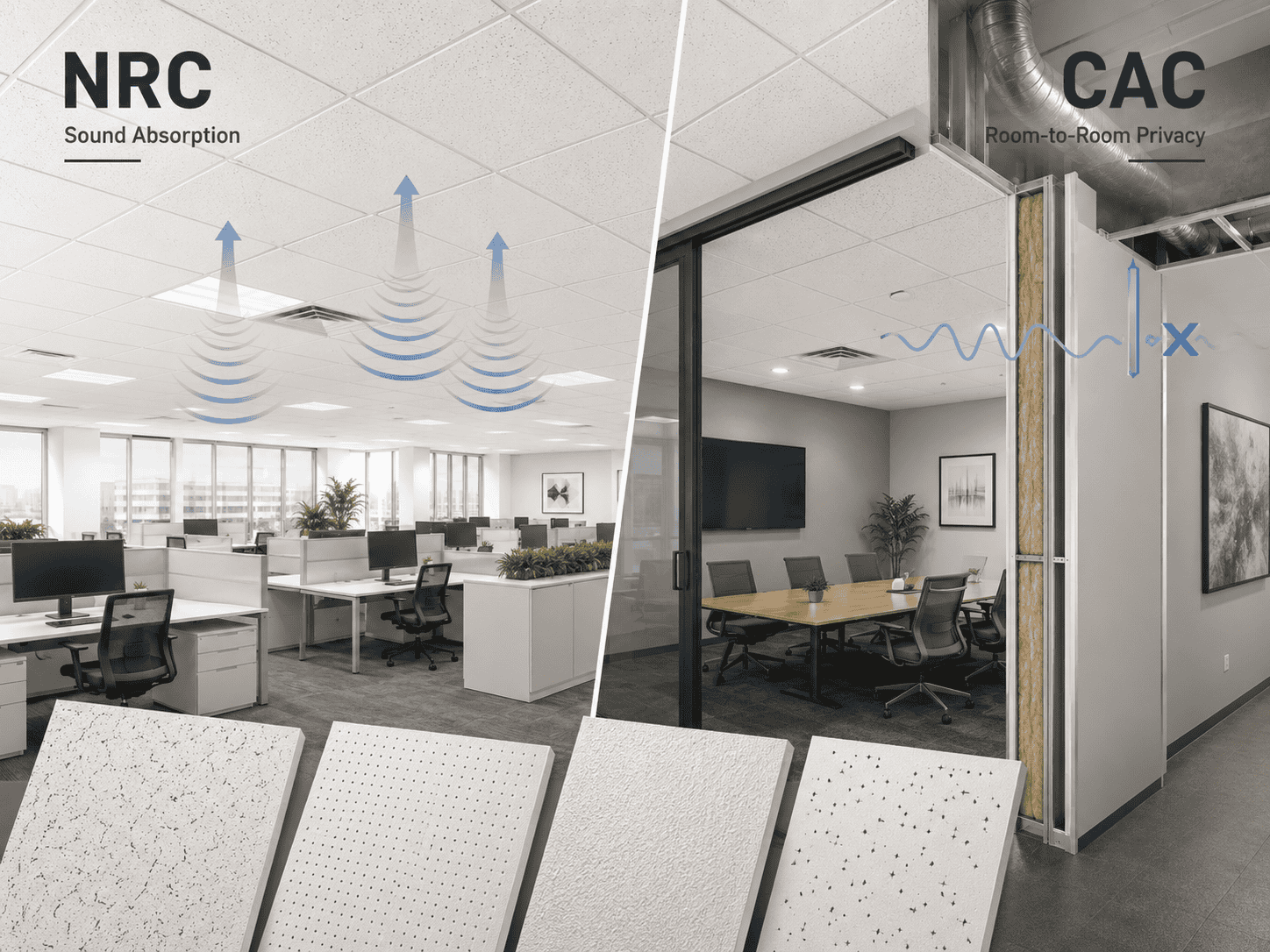
NRC and CAC measure two different aspects of ceiling acoustic performance. NRC focuses on how much sound a ceiling material absorbs within a room, while CAC relates to how effectively a suspended ceiling limits sound transmission between adjacent rooms through a shared ceiling plenum.
In simple terms:
- Need to reduce echo and reverberation? Focus on NRC.
- Need to improve sound privacy between rooms? CAC becomes more important.
- Need both acoustic comfort and privacy? Both ratings may matter.
Understanding this difference helps buyers select the right acoustic mineral fiber ceiling tiles for offices, classrooms, meeting rooms, healthcare spaces, and other commercial interiors.
What Is the Difference Between NRC and CAC?
The two ratings serve different acoustic purposes:
| Rating | NRC | CAC |
|---|---|---|
| Full Name | Noise Reduction Coefficient | Ceiling Attenuation Class |
| Main Function | Sound absorption | Sound attenuation between rooms |
| Main Question | How much sound is absorbed in the room? | How well does the ceiling limit sound passing to another room? |
| Typical Concern | Echo and reverberation | Speech privacy |
| Common Applications | Open offices, classrooms, public areas | Private offices, meeting rooms, enclosed spaces |
NRC and CAC should therefore not be treated as interchangeable values.
A ceiling tile can perform well in sound absorption without necessarily providing the same level of room-to-room sound attenuation.
What Does NRC Mean for Ceiling Tiles?
NRC, or Noise Reduction Coefficient, describes how effectively a material absorbs sound.
In a room with hard surfaces such as glass, floors, desks, walls, and furniture, sound can reflect repeatedly and create a noisy or uncomfortable environment.
A sound-absorbing ceiling helps reduce those reflections.
This can improve:
- Speech clarity
- Acoustic comfort
- Reverberation control
- Background noise conditions
NRC is especially relevant when the acoustic problem exists within the same room.
Where Is NRC Most Important?
NRC is commonly considered in spaces such as:
Open-plan offices
Conversations, phone calls, printers, and office equipment can create continuous background noise. A sound-absorbing ceiling can help reduce reflected sound.
Classrooms and training rooms
Poor reverberation control may reduce speech clarity and make it harder for occupants to hear clearly.
Call centers
A large number of simultaneous conversations can increase overall noise levels.
Conference spaces
Clear speech is important for discussions, presentations, and video meetings.
Large public interiors
Waiting areas, commercial halls, and transportation buildings may contain many sound sources and reflective surfaces.
For these environments, buyers should pay attention to actual sound-absorption data rather than relying only on terms such as “acoustic ceiling tile.”
What Does CAC Mean for Ceiling Tiles?
CAC, or Ceiling Attenuation Class, relates to sound transmission between adjacent rooms through a shared suspended ceiling plenum.
Consider two private offices separated by a partition that stops at the suspended ceiling.
Sound may travel:
- Up through the ceiling in one room
- Across the shared plenum
- Over the partition
- Down through the ceiling into the next room
CAC is relevant to this type of sound path.
Where Is CAC More Important?
CAC may be particularly important in:
- Private offices
- Meeting rooms
- Consultation rooms
- Interview rooms
- Management offices
- Enclosed classrooms
- Certain healthcare spaces
In these environments, sound privacy can matter just as much as reducing reverberation.
Does a Higher NRC Mean a Higher CAC?
No.
This is one of the most common misunderstandings when comparing acoustic ceiling products.
A ceiling tile designed to absorb sound effectively may not automatically provide strong sound attenuation between rooms.
Likewise, a system with stronger room-to-room sound blocking may have a different level of sound absorption.
Therefore:
High NRC does not automatically mean high CAC.
Buyers should always identify the actual acoustic problem before selecting a ceiling product.
If the problem is echo in an open office, NRC is likely to be the more relevant specification.
If the problem is speech traveling between adjacent private offices, CAC and the complete room construction should also be considered.
NRC or CAC: Which One Should You Prioritize?
A practical way to decide is to start with the room function.
| Acoustic Problem | Main Priority |
|---|---|
| Echo in an open office | NRC |
| Poor speech clarity in a classroom | NRC |
| Noise buildup in a call center | NRC |
| Reverberation in a public area | NRC |
| Speech heard in the next private office | CAC + room construction |
| Meeting room lacks privacy | CAC + room construction |
| Open office with enclosed meeting rooms | NRC and CAC may both matter |
This is more effective than simply asking a supplier for the “best acoustic ceiling tile.”
A better RFQ question is:
“Our project needs to reduce reverberation in an open office. Which mineral fiber ceiling tile is suitable?”
Or:
“Our meeting rooms share a ceiling plenum. What sound attenuation data is available for the ceiling system?”
These questions give the supplier much more useful information.
Why Is NRC Important for Open Offices?
Open-plan offices generally have a different acoustic challenge from enclosed rooms.
There may be few full-height walls between workstations, so room-to-room ceiling attenuation is not always the main issue.
Instead, speech and equipment noise can spread across the open space and reflect from hard surfaces.
This makes sound absorption especially important.
Ceilmart’s high acoustic mineral fiber ceiling tile is positioned for applications such as open offices, call centers, and coworking spaces where acoustic comfort is a key requirement.
However, buyers should still request the relevant technical data and test information rather than choosing a product only because it is described as “high acoustic.”
Is NRC Enough for Meeting Rooms and Private Offices?
Not always.
A meeting room may have good sound absorption inside the space but still lack privacy if sound travels through the ceiling plenum or other building elements.
A complete acoustic design may also need to consider:
- Partition height
- Wall construction
- Doors and seals
- HVAC openings
- Lighting penetrations
- Cable openings
- Plenum barriers
- Other flanking sound paths
This means ceiling performance should be considered as part of the complete room system.
CAC alone also does not guarantee final room privacy because actual field performance depends on the full building construction and installation conditions.
Does Ceiling Thickness Determine NRC?
Not by itself.
Buyers sometimes assume that a thicker mineral fiber ceiling tile automatically has better acoustic performance.
In reality, sound absorption can be influenced by:
- Core material
- Density
- Porosity
- Thickness
- Surface treatment
- Perforation pattern
- Backing material
- Installation method
- Ceiling plenum
Thickness is only one factor.
If a project has specific acoustic requirements, buyers should compare actual tested data rather than using thickness as the only purchasing criterion.
Does Surface Pattern Affect Acoustic Performance?
Surface pattern can form part of the acoustic design, but appearance alone does not tell buyers the NRC or CAC value.
Mineral fiber ceiling tiles may use:
- Fine fissures
- Micro-perforations
- Star patterns
- Snowflake textures
- Sand-textured surfaces
- Irregular patterns
Two ceiling tiles may look similar while providing different acoustic performance because the internal structure, density, thickness, and surface treatment can differ.
For this reason, technical data should always take priority over visual assumptions.
What Else Should Buyers Check Besides NRC and CAC?
Acoustic performance is only one part of ceiling tile selection.
Buyers should also consider:
Humidity resistance
Projects in tropical, coastal, or high-humidity environments may require enhanced dimensional stability. Ceilmart also provides an RH90 moisture-resistant ceiling tile for applications where humidity resistance is important.
Fire performance
Confirm the required fire standard, classification, and available test documentation.
Tile size and thickness
The selected ceiling tile must match the project drawings and suspension system.
Edge profile
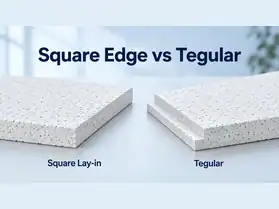
Square, tegular, concealed, and other edge types affect both appearance and installation.
Maintenance requirements
Commercial ceilings often need access to lighting, HVAC, electrical systems, and fire-protection equipment.
What Acoustic Information Should You Include in an RFQ?
Instead of sending an inquiry that only says:
“Need acoustic ceiling tiles. Please quote.”
Include:
- Building type
- Room type
- Main acoustic problem
- Required NRC, if specified
- Required CAC, if specified
- Tile size
- Thickness
- Edge type
- Humidity requirement
- Fire requirement
- Quantity
- Destination country
- Project specification or drawings
If the acoustic rating has not yet been finalized, explain the room function and the problem you are trying to solve.
This helps the manufacturer or supplier recommend a more suitable ceiling configuration.
How Should You Choose Between NRC and CAC?
The easiest way to remember the difference is:
NRC = sound absorption inside a room.
CAC = sound attenuation between adjacent rooms through a suspended ceiling system.
For open offices, classrooms, call centers, and common areas, sound absorption is often a major concern.
For private offices, meeting rooms, and consultation spaces, room-to-room privacy may also need to be considered.
For many commercial projects, the correct question is therefore not simply “NRC or CAC?”
The better approach is:
Identify the acoustic problem first, then select the ceiling performance that matches the room function and complete building design.
For distributors, contractors, and project buyers sourcing mineral fiber ceiling tiles, Ceilmart can provide product options for different commercial applications. Sharing the project type, acoustic requirements, tile specification, quantity, and destination market can help narrow the most suitable ceiling solution.