How to Choose Mineral Fiber Ceiling Tiles for Commercial Projects: A Buyer’s Guide
News 2026-08-27
Choosing the right mineral fiber ceiling tiles for a commercial project requires more than comparing appearance or price. Buyers should evaluate the building application, acoustic requirements, humidity conditions, fire performance, tile size and thickness, edge profile, ceiling grid compatibility, and required technical documentation.
For importers, distributors, contractors, and project buyers, defining these requirements before requesting a quotation makes it easier to compare products and avoid specification or installation problems later.
What Should You Check Before Buying Mineral Fiber Ceiling Tiles?
The most important selection factors include:
| Selection Factor | What to Check | Why It Matters |
|---|---|---|
| Application | Office, school, hospital, hotel, retail, etc. | Different spaces have different performance priorities |
| Acoustics | NRC, sound absorption, sound-control requirements | Affects reverberation and indoor acoustic comfort |
| Humidity | Relative humidity and climate conditions | Helps reduce sagging and deformation risks |
| Fire performance | Required standard and test documentation | Important for project compliance |
| Size & thickness | Ceiling module and project specification | Must match system design |
| Edge profile | Square, tegular, concealed, etc. | Affects appearance and installation |
| Grid compatibility | Tile and suspension-system dimensions | Prevents installation mismatch |
| Surface design | Texture, perforation, color | Influences architectural appearance |
| Documentation | Data sheets, test reports, samples | Important for purchasing and project approval |
The right product should therefore be selected according to the complete project requirement rather than one isolated specification.
How Does the Building Application Affect Ceiling Tile Selection?
The first question should be:
Where will the ceiling tile be installed?
An office, classroom, hotel, hospital, and transport terminal can all require different ceiling performance.
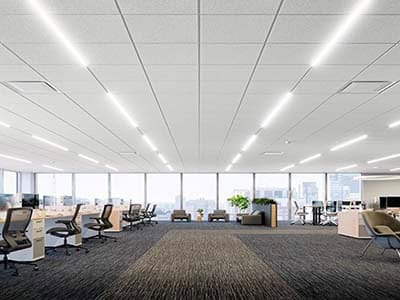
Offices
Office ceilings usually need to balance sound absorption, appearance, maintenance access, and integration with lighting and HVAC systems.
Open-plan offices often place greater emphasis on acoustic performance because conversations, phone calls, and office equipment can create continuous background noise.
For these environments, an acoustic mineral fiber ceiling tile may be more appropriate than selecting a ceiling tile mainly for decorative appearance.
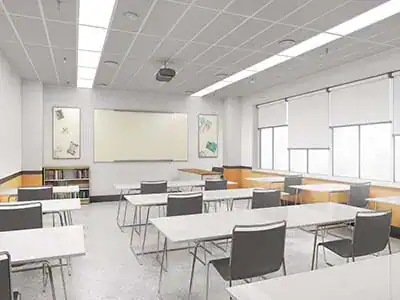
Schools and Educational Buildings
Classrooms and learning spaces often require:
- Good sound absorption
- Speech clarity
- Durability
- Fire performance
- Easy maintenance
Acoustic performance is particularly important because excessive reverberation can make speech more difficult to understand.
Hotels and Commercial Interiors
Hotels, shopping centers, restaurants, and showrooms usually need to balance visual design with practical performance.
Surface texture, edge design, acoustic requirements, humidity conditions, and grid visibility should all be considered.
High-Humidity Projects
Projects in tropical, coastal, or consistently humid environments require greater attention to dimensional stability and moisture resistance.
In these situations, humidity performance can be just as important as appearance or acoustics.
How Important Is Acoustic Performance?
Acoustics is one of the main reasons mineral fiber ceiling tiles are used in commercial interiors.
However, buyers should not simply ask:
“Do you have acoustic ceiling tiles?”
A more useful question is:
“What acoustic problem does this project need to solve?”
Two terms are commonly used when evaluating commercial ceiling acoustics:
- NRC — Noise Reduction Coefficient: relates to how much sound a material absorbs within a room.
- CAC — Ceiling Attenuation Class: relates to how effectively a suspended ceiling system limits sound transmission between adjacent spaces through a shared ceiling plenum.
If the main problem is echo or reverberation in an open office, sound absorption is usually a major priority.
If the project contains private offices or meeting rooms where conversations should not easily travel between spaces, sound attenuation may also be important.
Buyers should therefore request actual acoustic performance data rather than relying on general descriptions such as “high acoustic.”
How Does Humidity Affect Mineral Fiber Ceiling Tiles?
Humidity can affect the dimensional stability of suspended ceiling products.
Long-term exposure to elevated humidity may increase the risk of:
- Sagging
- Edge deformation
- Warping
- Uneven ceiling surfaces
This is particularly relevant in tropical, subtropical, coastal, or poorly conditioned environments.
For projects where moisture resistance is important, buyers should confirm the relative-humidity rating and intended application conditions.
Ceilmart currently provides an RH90 moisture-resistant ceiling tile option for commercial interiors where increased humidity resistance is required.
However, an RH rating should not be considered independently. Condensation, ventilation, temperature, direct water exposure, and installation conditions can also affect ceiling performance.
When requesting a quotation, it is therefore useful to tell the supplier the destination country and intended application.
What Fire Performance Should Buyers Check?
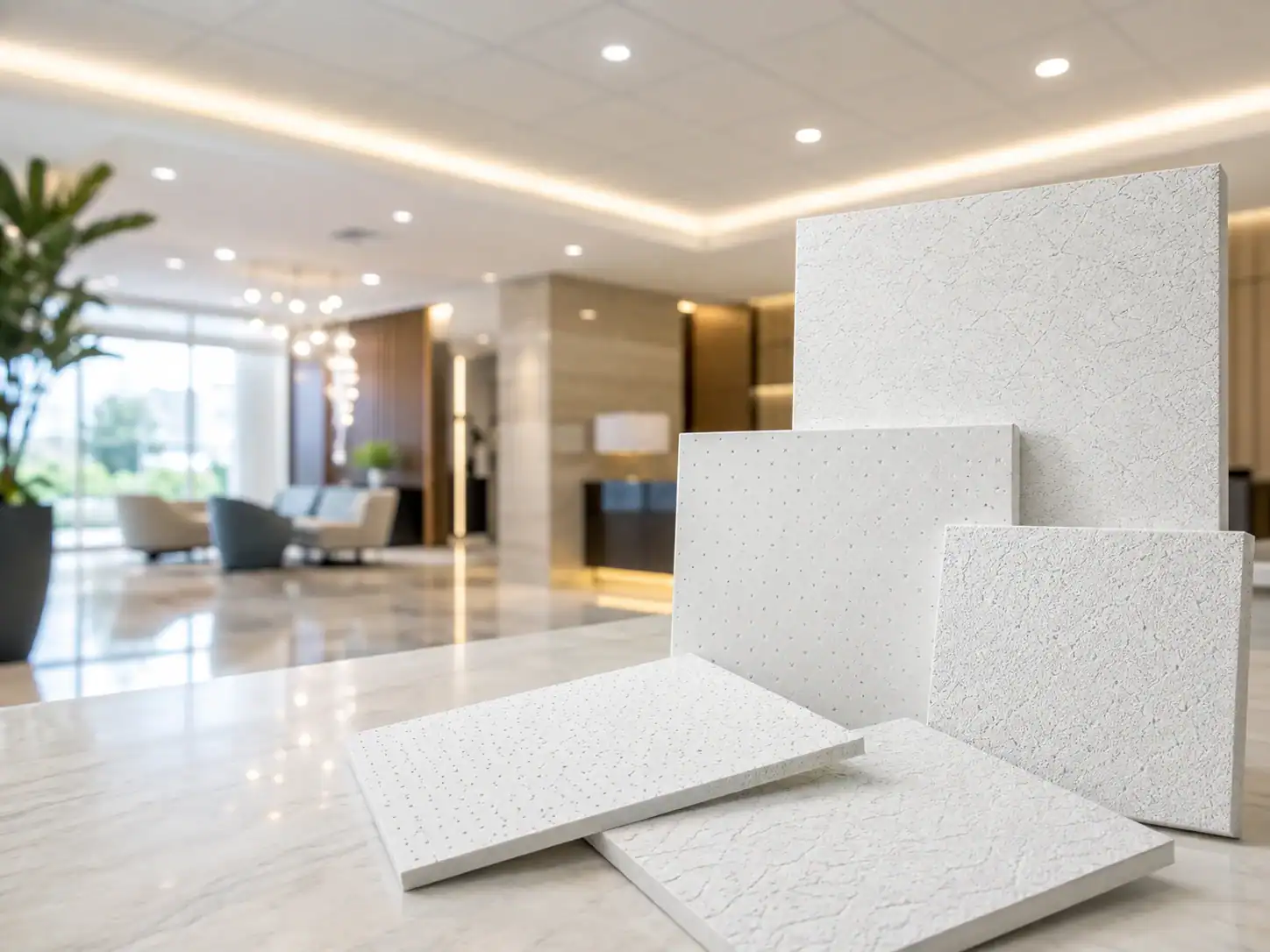
Fire performance is another important factor in commercial ceiling specifications.
A common purchasing mistake is assuming that all mineral fiber ceiling tiles have the same fire classification because they use similar base materials.
Instead, buyers should confirm:
- Which fire standard applies to the project
- Which classification is required
- Whether the specific product has been tested
- Whether a valid test report is available
- Whether the report applies to the exact product being supplied
Requirements can vary by country, building type, consultant, and local regulations.
For export projects, these requirements should ideally be clarified during the RFQ stage rather than after an order has been placed.
What Size and Thickness Should You Choose?
Ceiling tile dimensions must correspond with the project drawings and suspension-system layout.
Common mineral fiber ceiling tile dimensions include:
- 595 × 595 mm
- 600 × 600 mm
- 603 × 603 mm
- 595 × 1195 mm
- 600 × 1200 mm
- 603 × 1210 mm
- 300 × 1200 mm
Available thicknesses may include 12 mm, 14 mm, 15 mm, 16 mm, and 18 mm depending on the product.
However, buyers should avoid assuming that a thicker tile automatically means better overall performance.
Acoustic performance, weight, dimensional stability, surface treatment, density, and installation requirements can all depend on the complete product design.
The project specification should therefore take priority over thickness alone.
Which Ceiling Tile Edge Should You Choose?
Edge profile affects both the finished appearance and the way the ceiling tile works with the suspension grid.
Square Edge
Square-edge tiles sit directly on an exposed grid.
They are commonly selected for projects that prioritize:
- Simple installation
- Easy replacement
- Convenient access above the ceiling
- Straightforward maintenance
Tegular Edge
Tegular tiles sit slightly below the grid face, creating a recessed visual effect.
They are often used where buyers want more architectural depth while maintaining relatively easy access to the ceiling plenum.
Concealed Edge
Concealed-edge systems reduce the visual presence of the suspension grid and can create a cleaner ceiling appearance.
Ceilmart’s mineral fiber ceiling tile range includes square, tegular, concealed, and ultra-concealed edge options.
The important point is that the tile edge and ceiling grid should always be selected together.
Why Does Ceiling Grid Compatibility Matter?
A mineral fiber ceiling tile is one component of a complete suspended ceiling system.
Other components may include:
- Main runners
- Cross tees
- Wall angles
- Hangers
- Lighting
- HVAC diffusers
- Sprinklers
- Access points
If the panel dimensions or edge profile do not match the grid configuration, installation problems can occur even when the ceiling tile itself meets the required performance specification.
This becomes especially important when ceiling panels and suspension components are purchased separately.
Where possible, buyers should evaluate the ceiling tile and ceiling T-grid system as one system.
For an RFQ, provide the grid width, ceiling module, tile dimensions, and edge profile whenever these details are already specified.
Does Surface Pattern Matter?
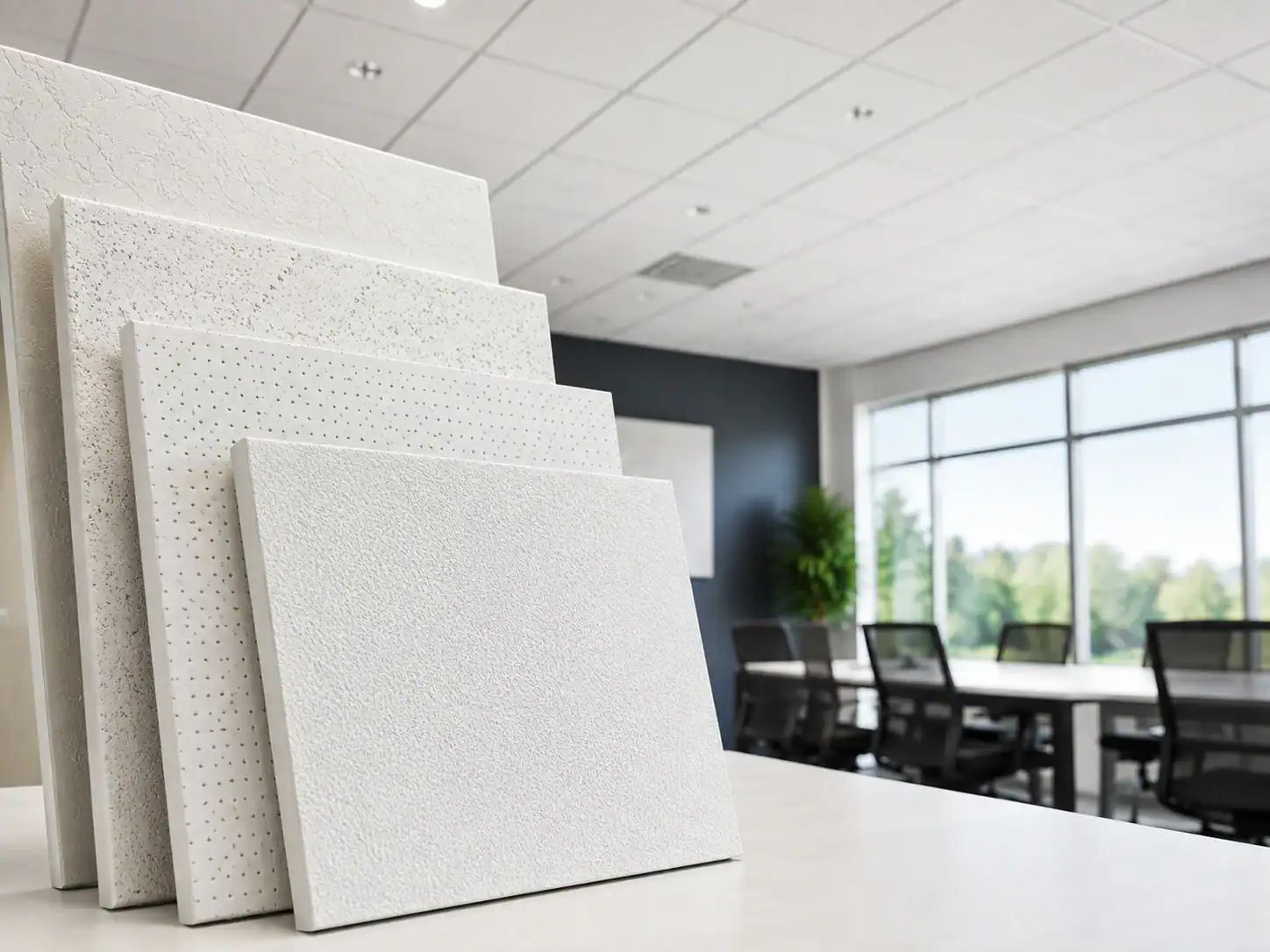
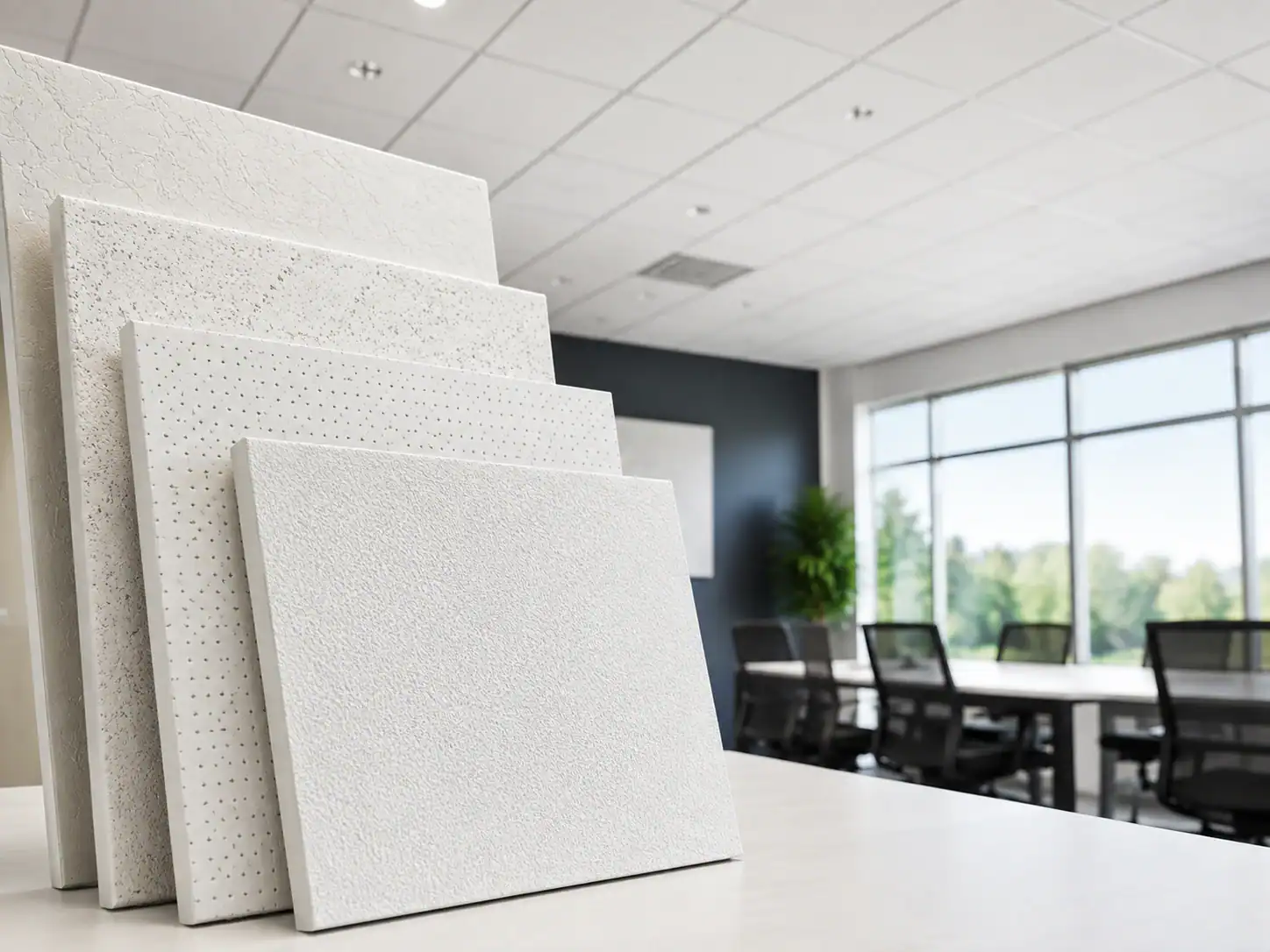
Surface pattern mainly influences appearance, but it can also form part of the overall acoustic design of a ceiling tile.
Mineral fiber ceiling tiles may use:
- Fine fissures
- Perforations
- Sand-textured finishes
- Linear patterns
- Irregular textures
- Relatively smooth surfaces
Buyers should not judge acoustic performance from appearance alone.
Two products with similar surface patterns may have different acoustic properties because performance also depends on the core material, density, thickness, porosity, and overall construction.
For distributors, surface selection also affects inventory planning. A small number of versatile designs may be easier to stock across multiple projects, while architectural projects may require a specific finish.
Physical samples are therefore useful before confirming larger orders.
What Documents Should Importers Request?
For B2B purchasing, product appearance is only one part of supplier evaluation.
Depending on the project, buyers may request:
- Technical data sheets
- Product dimensions and tolerances
- Acoustic test information
- Fire-performance documentation
- Humidity-resistance information
- Packaging specifications
- Samples
- Loading quantities
- Lead-time information
- OEM or private-label options
The required documents will vary by destination market and project specification.
For project orders, drawings and specification documents should be shared with the supplier whenever possible.
Which Mineral Fiber Ceiling Tile Is Suitable for Different Projects?
The following table provides a useful starting point:
| Project Type | Main Selection Priorities |
| Open office | Sound absorption, appearance, maintenance |
| Private office | Acoustics, privacy requirements, appearance |
| Classroom | Speech clarity, durability, fire performance |
| Hospital | Compliance, maintenance, acoustic requirements |
| Hotel | Appearance, acoustics, humidity |
| Shopping mall | Durability, appearance, maintenance |
| Tropical/coastal project | Humidity resistance, dimensional stability |
| Airport/station | Acoustics, fire requirements, system compatibility |
This is only a screening guide. Final product selection should always follow project specifications, drawings, local standards, and actual operating conditions.
What Information Should You Include in an RFQ?
A detailed RFQ helps suppliers recommend the correct product and prepare more accurate quotations.
Include as much of the following information as possible:
- Destination country
- Project type
- Tile size
- Thickness
- Edge profile
- Surface pattern
- Acoustic requirements
- Humidity requirements
- Fire-performance requirements
- Quantity
- Ceiling grid requirement
- Packaging or OEM requirements
- Required test documentation
- Destination port
If some specifications have not yet been finalized, provide the building application and ceiling drawings so that suitable options can be evaluated.
How Do You Make the Final Selection?
Before placing an order, confirm five questions:
Does the ceiling tile meet the functional requirements of the space?
Does it match the specified suspension grid?
Are acoustic, humidity, and fire requirements clearly defined?
Have samples and relevant technical documents been reviewed?
Is the quoted configuration the same product that will be supplied in bulk?
The best mineral fiber ceiling tile is not necessarily the thickest or most expensive option. It is the product whose acoustics, humidity resistance, dimensions, edge profile, appearance, documentation, and suspension system match the actual commercial project.
For distributors, contractors, and project buyers sourcing mineral fiber ceiling tiles, Ceilmart provides mineral fiber ceiling panels and suspended ceiling system options for different commercial applications. Buyers can provide project specifications, drawings, quantities, and destination-market requirements when discussing the appropriate configuration.